Running vs Non-Running: How Much Does It Change Your Car's Price?
“Does it run?” is the first question every car buyer asks. It sounds like a yes-or-no question, but buyers don’t actually think about it that way. To a buyer, there are at least five different levels between “drives perfectly” and “completely seized” — and each one has a different price.
This guide explains those levels, roughly how much each one is worth, why the gap is bigger on some vehicles than others, and the handful of cheap checks worth doing before you sell. It’s written for Edmonton, where a lot of “non-running” cars are really just cars that lost a fight with a cold snap.
The Short Answer
On an older vehicle that’s already near the end of its life, running versus not running often changes the offer by somewhere between a hundred and a few hundred dollars. On a newer or in-demand vehicle — a late-model SUV or a common pickup — the difference can be a thousand dollars or more, because a running vehicle can be resold or its drivetrain tested and sold as working parts.
The key idea: the more a vehicle is worth as transportation, the more “running” matters. The more it’s worth as material, the less it matters.
The Five Levels Buyers Actually Use
When you describe your car, a good buyer is mentally placing it into one of these levels.
| Level | What it means | How buyers see it | Effect on price |
|---|---|---|---|
| 1. Runs and drives | Starts, moves under its own power, stops and steers | Possibly resaleable whole; every part can be tested | Highest |
| 2. Runs but doesn’t drive | Engine runs; transmission, axle or steering problem | Engine proven good and sellable as a part | High–middle |
| 3. Cranks, no start | Engine turns over but won’t fire | Engine probably intact; cause unknown | Middle |
| 4. No crank | Nothing happens, or just a click | Could be a battery — or something serious | Middle–low |
| 5. Seized or major failure | Engine locked, thrown rod, cracked block, fire, flood | Priced on metal, converter and non-engine parts | Lowest (but never zero) |
Telling a buyer exactly which level your car is at gets you a more accurate quote than a simple “it doesn’t run.” It also means the number won’t change when the truck arrives.
Why the Gap Is Bigger on Some Vehicles
When running matters a lot
Newer vehicles, popular SUVs and common pickups have working engines and transmissions that are in demand. A running F-150 or Silverado has a proven drivetrain somebody wants. Lose the “running” status and the buyer is guessing — so the offer drops to protect against the worst case.
When running barely matters
On an older, high-kilometre car with rust, limited parts demand, or a missing converter, most of the value is already the metal. Whether it starts or not, it’s heading for the same place. That’s why a 20-year-old compact that runs and one that doesn’t can get surprisingly similar offers. You can see where your model sits in our Edmonton scrap value guide by model.
The things that matter more than “running”
Two non-running cars can still be worth very different amounts. Completeness, the catalytic converter, and rust often move the number more than whether the engine fires. A complete, rust-light, non-running SUV with its original converter can easily outvalue a running car that’s been stripped. For more on that, read how the catalytic converter changes your offer.
Edmonton’s Most Common “Non-Running” Cars Aren’t Always Dead
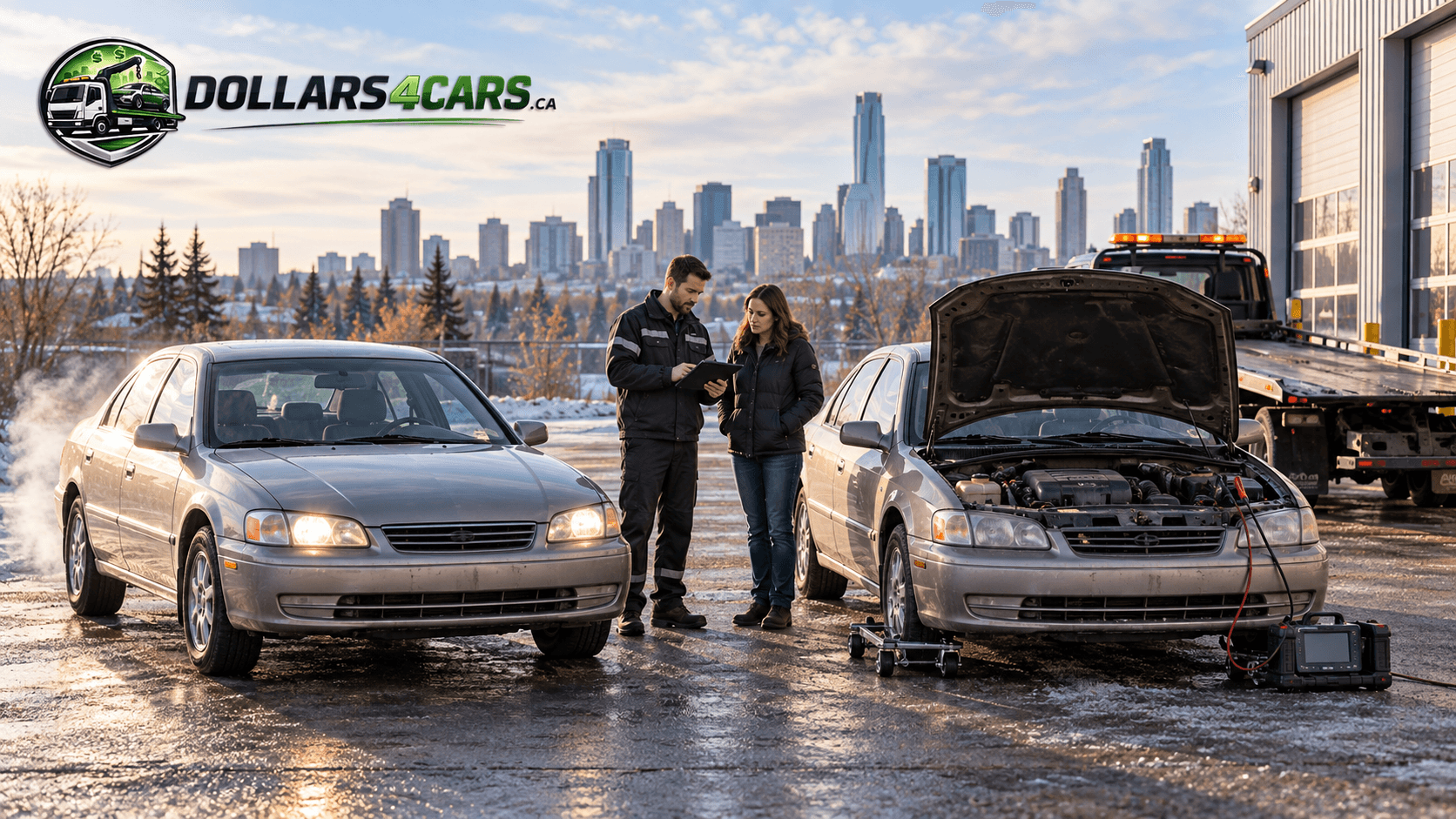
A huge share of the calls we get between December and March are cars that stopped during a deep freeze. Some are genuinely finished. Others just need one cheap thing. Before you sell, it’s worth ruling out the inexpensive causes.
Cheap checks worth trying first
- The battery. Cold kills weak batteries. If the car just clicks or the dash lights are dim, a boost or a replacement battery is the first thing to try.
- The block heater cord. A cut or failed cord means the engine never got warmed, and a hard start follows. Check the cord end for damage.
- Fuel. A nearly empty tank in extreme cold can cause trouble, and diesel can gel if the fuel isn’t winter-grade. Fuel conditioner and a warm garage sometimes solve it.
- Simply waiting for a warmer day. If it cranked slowly at −32°C, try again when it’s −10°C before deciding.
Signs it’s something bigger
- Coolant mixed with oil, or white smoke and a sweet smell — possible head gasket or cracked block.
- A loud knock or a seized engine that won’t turn at all.
- A slipping or non-engaging transmission.
- Warning lights and a repair quote that’s more than half the car’s value.
If you’re seeing any of these, it’s usually time to price the car as-is rather than spend more on it.
Should You Fix It Before Selling?
Here’s the simple rule we give people: only spend money before selling if the repair is cheap, certain, and moves the car up a level.
Worth trying
A $150–$250 battery that turns a “no crank” into a “runs and drives.” That’s a cheap, certain fix that can move the offer by more than it costs — especially on a vehicle people still want to drive.
Usually not worth it
Diagnostic work on an unknown no-start, a used engine or transmission swap, head gasket repairs, or anything where the quote starts with “it could be.” You’ll rarely get that money back in a higher offer, and you risk spending it on the wrong fix.
The 50% test
Take the repair quote and compare it with what the car would be worth once fixed — not what you paid for it. If the repair costs more than half of that finished value and the car is older or high-kilometre, selling as-is almost always makes more sense. There’s usually another repair waiting behind the first one.
How to Describe Your Car So the Quote Is Accurate
A precise description gets you a precise number that holds. When you call, tell the buyer:
- The year, make, model and engine.
- Which of the five levels above it’s at — and what happens when you turn the key.
- When it last ran, and what happened right before it stopped.
- Anything you know is wrong: a mechanic’s diagnosis, warning lights, noises, leaks.
- Anything that’s missing — battery, wheels, converter, engine parts.
- Where it’s parked and whether it rolls, steers and has keys.
“It cranks but won’t start since the cold snap in January, mechanic thinks it’s the fuel pump, all four tires are flat, keys available” is a description a buyer can quote firmly. “It doesn’t run” isn’t.
Getting a Non-Running Car Out of an Edmonton Driveway
A car that won’t start can’t be driven onto a truck, so the buyer has to bring the right equipment. A good buyer handles all of this as part of the job:
- Flat deck and winch for anything that won’t move under its own power.
- Wheel skates for flat tires, locked brakes or missing wheels.
- Planning for access — back alleys, attached garages, parkades and snowbanks.
None of that should cost you anything. With Dollars4Cars, towing is free and never deducted, whether the car is in an open driveway or frozen into a windrow. Our junk car removal service is built for exactly these pickups.
Frequently Asked Questions
How much is a car that doesn’t run worth?
Most complete non-running passenger cars bring roughly $250 to $900 in Edmonton in 2026, with SUVs, minivans and trucks higher. Completeness, rust and the converter matter as much as whether it starts.
Will I get more if I fix it first?
Only if the fix is cheap, certain and moves the car up a level — like a new battery. Bigger repairs rarely pay for themselves.
Does a seized engine make my car worthless?
No. The metal, converter and many non-engine parts still have value.
My car hasn’t started since winter. Is that normal?
Very. Cold-related no-starts are some of the most common calls we get. Try a battery first; if that doesn’t fix it, price it as-is.
Do I need the keys?
No. We can collect a car without keys, though having them helps with steering and moving it.
Can you pick up a car that won’t roll?
Yes. Skates and a winch handle locked wheels and flat tires.
Find Out What Yours Is Worth — Running or Not
Tell us which level your car is at and what you know about it, and we’ll give you a firm number that includes free towing. Dollars4Cars buys running and non-running vehicles across Edmonton and nearby communities like Spruce Grove and Beaumont, with payment at pickup.