Intake and identification
The VIN is recorded and matched against your registration and bill of sale. Ownership is verified before anything else happens. Where salvage status applies, the proper registrar notification has to happen too.
Why It Matters
Here's the thing that surprises people: you cannot take a car to a City facility. Edmonton's waste system handles automotive material in pieces. Residents can drop off motor oil, oil filters, antifreeze, brake and transmission fluid, gasoline and diesel, car batteries, and passenger tires at the right facilities, and scrap metal can go to the Residential Transfer Station.
What none of those facilities are set up for is an assembled motor vehicle. A car at end of life still contains engine oil, transmission and differential fluid, coolant, brake and power steering fluid, fuel, washer fluid, air conditioning refrigerant, a lead-acid battery, and a catalytic converter holding precious metals.
Until those are removed and routed correctly, it is not scrap metal — it is a sealed container of regulated substances on four wheels. Somebody has to do that work. That is what an auto recycler is for, and it is why whole vehicles go to recyclers rather than landfills.
What This Solves
The VIN is recorded and matched against your registration and bill of sale. Ownership is verified before anything else happens. Where salvage status applies, the proper registrar notification has to happen too.
Fuel, engine oil, gear oil, coolant, brake fluid, and power steering fluid are drained into separate streams. The battery comes out, air-conditioning refrigerant is captured, tires come off, and regulated components are separated correctly.
Anything with remaining service life is removed and inspected — engines, transmissions, alternators, starters, differentials, transfer cases, radiators, doors, hoods, tailgates, glass, seats, wheels, modules, lighting, and the catalytic converter.
Process
Recover usable parts and remove the catalytic converter for precious-metal recovery.
Reduce the vehicle to a stripped hulk that is mostly steel, plus aluminum and copper-bearing material.
Process the shell through shredding and material separation, splitting ferrous and non-ferrous streams.
Route recovered steel and other materials back into manufacturing rather than leaving the vehicle as waste.
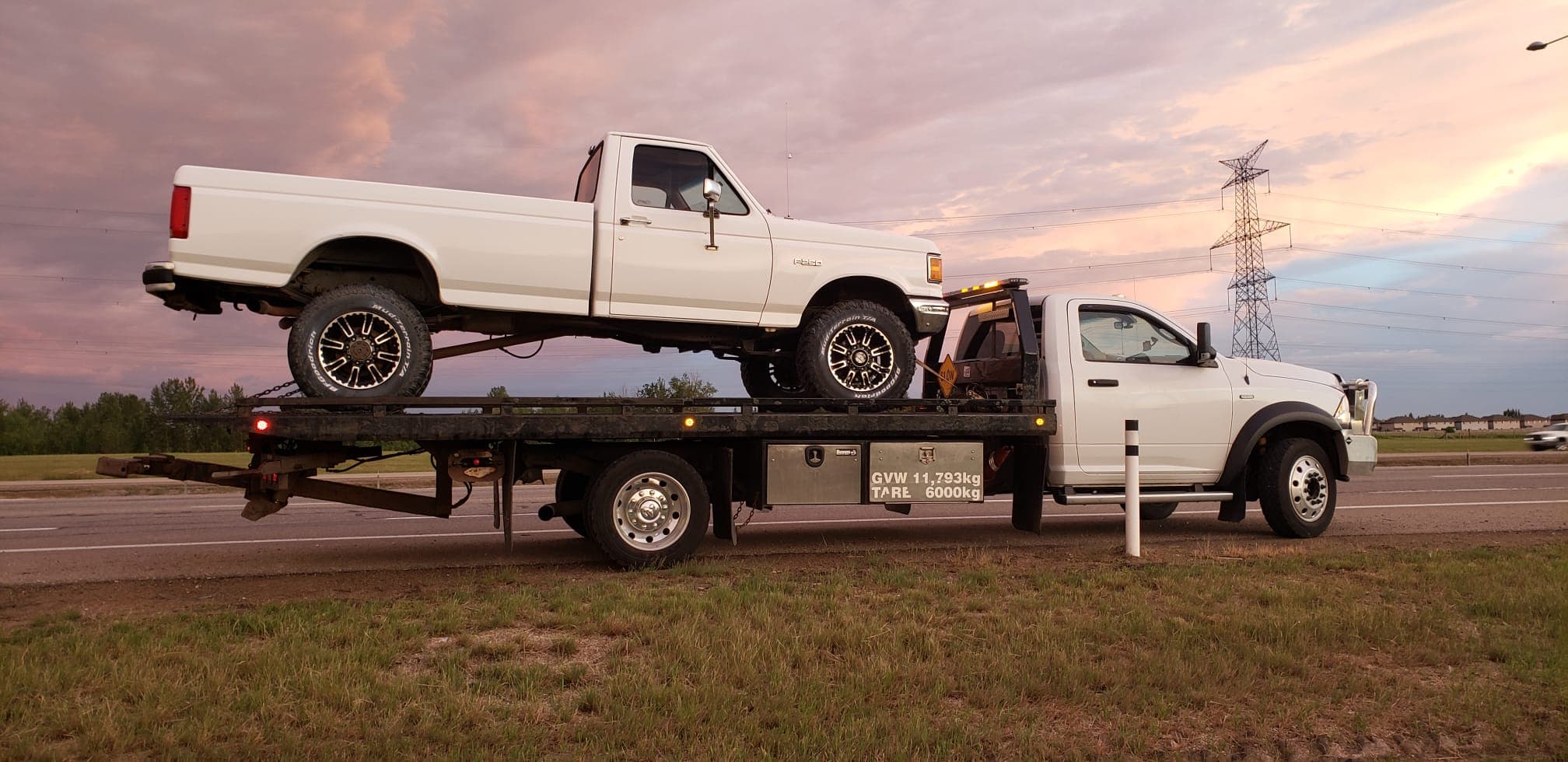
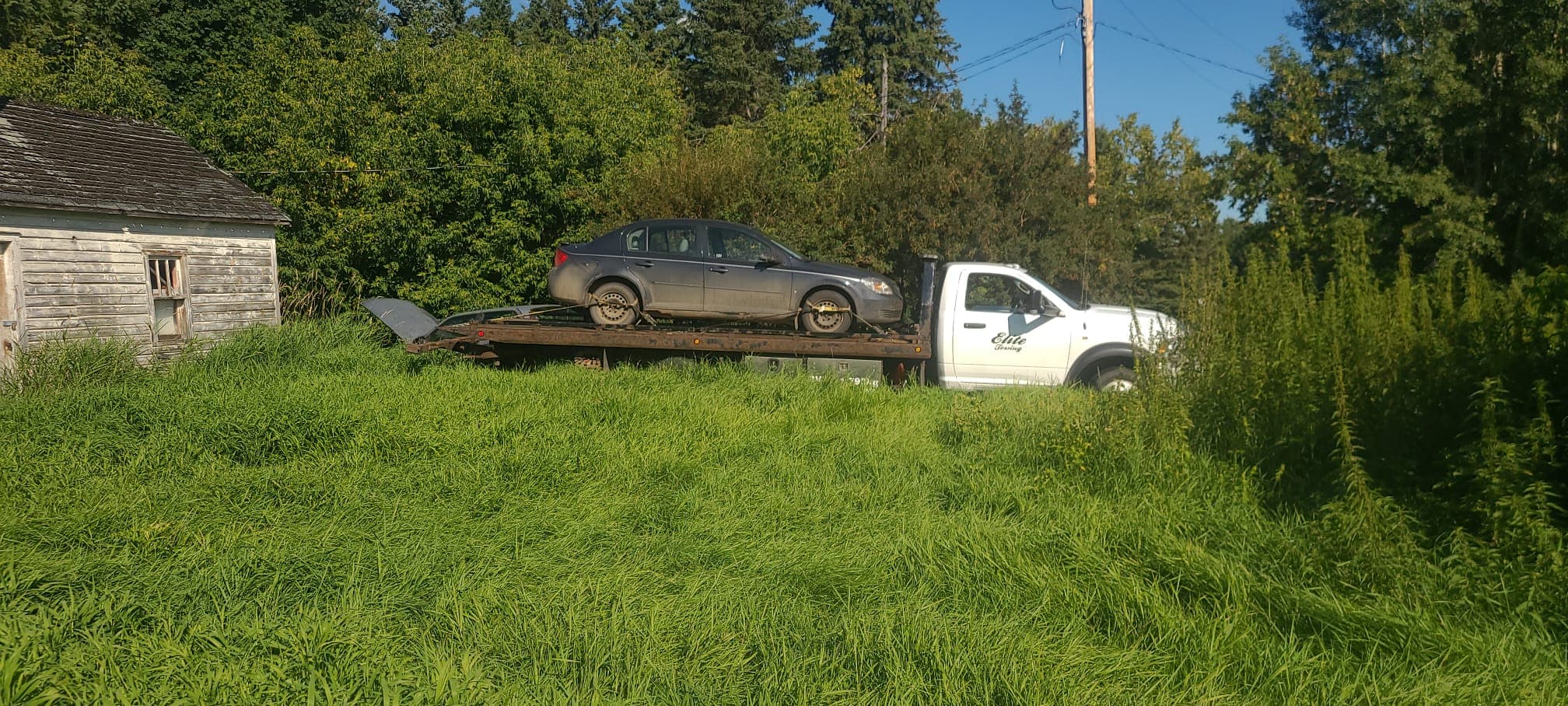
Collection is free and included. We run wheel-lift and flatbed equipment plus winching, which covers the realistic range of Edmonton-area scrap pickups.
Rear alleys in older neighbourhoods, tight infill lots, and vehicles that have not rolled in a decade are normal work here.
Low-clearance residential parkades downtown and in Oliver and Garneau need the right extraction plan before a flatbed ever gets involved.
Gravel approaches, soft ground, and shop-adjacent or tree-line vehicles in Sturgeon, Parkland, Leduc, and Strathcona counties are part of the regular route.
Same-day pickup is standard for many morning calls in Edmonton, St. Albert, Sherwood Park, Fort Saskatchewan, Spruce Grove, Stony Plain, Beaumont, Leduc, Nisku, and Devon. Further-out routes are usually scheduled within a day or two.
Frozen-to-ground vehicles, seized brake drums, and snowed-in approaches change the recovery time more than they change the job itself. Clearing a path helps.
The paperwork is simple if it is handled at the vehicle. We complete the bill of sale at pickup with the VIN, date, and amount so you have a clean record of when the vehicle stopped being your responsibility.
If your vehicle is at the end of its life, tell us the year, make, model, honest condition, and where it is parked. We will give you a firm cash offer in minutes, collect it for free, and make sure it is processed properly.
Common Questions
City facilities handle automotive parts, fluids, batteries and tires — not whole vehicles. Complete cars go to auto recyclers.
You get paid. The vehicle contains recoverable material and parts with real value, which is what funds the free collection.
Still fine. It's priced on what's recoverable, and heavily weathered vehicles are routine.
Yes, though removed components reduce the value — the parts you sold separately are usually worth less than what they subtract from the offer.
No. Multiple vehicles at one property improve the per-unit offer, since one trip covers all of them.
They're separated during depollution and routed to the appropriate recycling streams rather than going out with the shell.