
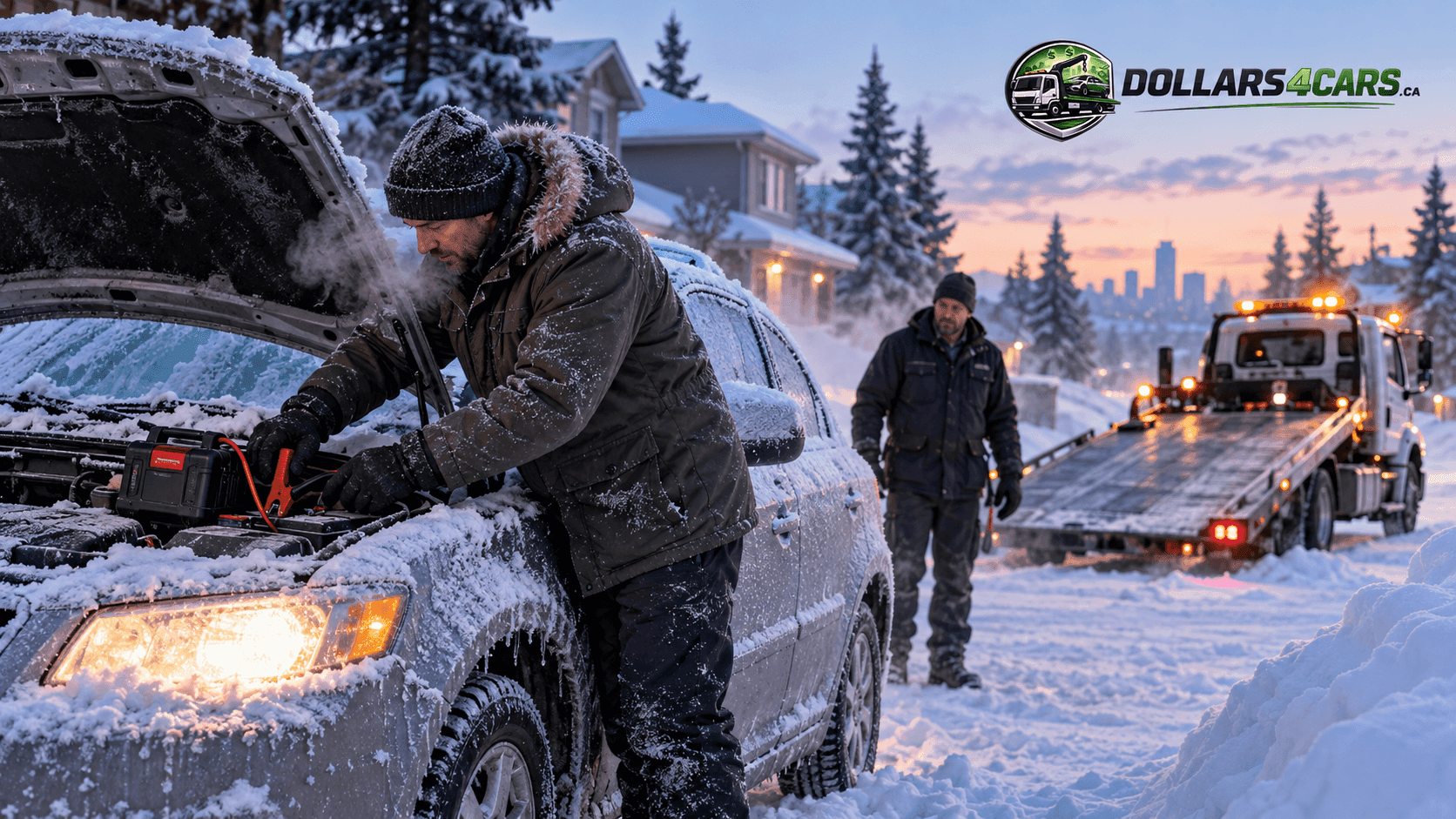
It Won't Start and It's -35. Repair, Boost, or Sell?
There is a particular sound every Edmonton driver knows. Not the healthy crank, not silence, but the slow grinding turnover that gets slower with each attempt until it becomes a click. It is seven in the morning, the windscreen is white on the inside, and you have about four minutes to decide what to do.
Most people make that decision badly, because they make it in the cold while already late. This guide is meant to be read before that morning, so you know which of the three doors you are choosing between: boost it, repair it, or accept that the car has reached the end. If your car won't start in cold Edmonton weather, the symptom itself can tell you a great deal.
Why Edmonton Is Harder on Cars Than Almost Anywhere
Cold is not a single problem. It is four or five separate problems that arrive together and feed each other, which is why a vehicle that was fine in October can be immovable in January.
A lead-acid battery loses a substantial share of its cranking power as the temperature drops, while the engine it has to turn over needs considerably more power because the oil inside has thickened. The demand goes up at the exact moment the supply goes down. That is the whole mechanism, and everything else is a variation on it.
The Alberta Motor Association recommends plugging in a parked vehicle once temperatures reach -15C or colder. Their own survey found that roughly seven in ten drivers do not plug in correctly, and 27 per cent do not plug in at all. That gap is where most January no-starts come from. It is not that Edmonton drivers do not own block heaters. It is that the heater is not plugged in, or the cord has failed, or the outlet is dead and nobody noticed until the morning it mattered.
What Actually Failed: A Four-Minute Diagnosis
Before you call anyone, the symptom narrows it down considerably. Work through these in order.
Dashboard lights are dim or absent, and you hear a single click
This is almost always the battery. Interior lights that are weak or dead confirm it. Batteries typically last four to six years, and AMA recommends testing yours after three. A battery that was slightly weak in September is a battery that fails at -30.
It cranks slowly but will not catch
The battery has enough charge to turn the engine but the engine is too cold to fire, or the oil is too thick to allow a proper crank speed. This is the classic unplugged block heater result. It is often recoverable.
It cranks normally and still will not start
Now you are looking at fuel or spark rather than cold. Gelled fuel lines, moisture frozen in the fuel system, or a failed sensor. This one is less likely to resolve itself with a boost, and it is the symptom most likely to mean a real repair.
Nothing at all, no lights, no click
Completely dead battery, a failed connection, or corroded terminals. Check the terminals before assuming the worst. Corrosion is common, visible, and cheap to fix.
It starts but will not move
Brakes frozen to the rotors, or a parking brake cable seized. Common on vehicles that sat through a thaw and refreeze cycle. Not a starting fault at all, and worth knowing before you pay somebody to diagnose one.
The Boost Trap
A boost is the obvious first move and often the right one. But it is worth understanding what a boost does and does not tell you.
If the vehicle starts on a boost, runs, and then starts again unaided the next morning, your battery was flat rather than dead and something drained it. If it starts on a boost and will not start again the following day, the battery is finished. If it will not hold a charge after being driven for half an hour, the alternator may be the real problem rather than the battery.
Where people lose money is repeating the boost. Three or four callouts across a cold snap, plus a tow, plus a diagnostic fee, can add up to a figure approaching what the car is worth before anybody has fixed anything. During extended cold snaps, roadside assistance wait times in Alberta stretch considerably, so each attempt also costs you a morning.
Deciding Whether to Repair
Once you know roughly what is wrong, the arithmetic is straightforward. Compare the repair against what the vehicle would realistically sell for in working condition.
A battery replacement on an otherwise sound car is almost always worth doing. It is the cheapest fix on this list and it buys you several years. Terminal cleaning, a new block heater cord or a replaced outlet are similarly small.
The picture changes with the bigger items. A starter, an alternator, a fuel pump or a sensor diagnosis on an older high-mileage vehicle can run into the kind of money where you are spending a meaningful fraction of the car's total value to get it moving again. And on a vehicle past about twelve years, one repair tends to reveal the next.
Three questions worth answering honestly before you commit:
- Is this the first cold-weather failure, or the third in two winters?
- Was the car already on a list of things you were putting off, such as rust, a transmission that hesitates, or an exhaust that needs work?
- If you spend this money, do you expect to keep the vehicle for another two winters, or are you buying a few months?
If the honest answer to the last one is a few months, you are not repairing the car. You are renting it from yourself at a poor rate.
The Hidden Cost of Leaving It
The most common outcome is none of the three options. The car stays where it is, the owner borrows a vehicle or takes transit, and the decision gets postponed until spring.
That is the most expensive choice available, because an Edmonton winter does not pause while you think. A dead battery sulfates and becomes unrecoverable. Brakes seize harder to the rotors with each thaw cycle. Tires develop flat spots. Mice find the engine bay insulation, and the damage they do to wiring is invisible until somebody tries to diagnose it. Road salt continues working on the underside the entire time.
A car that would have had real value in November is a different proposition in April. The mechanical problem has not changed, but the vehicle around it has deteriorated, and so has the offer anyone will make on it.
When Selling Is the Right Answer
There is no shame in a car reaching the end during an Edmonton cold snap. That is what finishes most vehicles here, the way hail finishes them further south.
Selling makes sense when the repair cost approaches half the vehicle's working value, when this is the second or third winter failure, when the car has existing problems you were already deferring, or when you need the driveway space and the registration renewal is coming up.
The useful thing to know is that a non-running vehicle still carries real value. The engine and transmission may be fine. The catalytic converter is still there. The wheels, panels, alternator, starter and radiator all have a market, and the shell itself is sold by weight once the parts come off. Our guide to how running condition changes a car's price explains the gap in detail, and it is smaller than most owners assume.
If the vehicle cannot be driven or will not roll, that is normal rather than an obstacle. Free towing covers seized, snowed-in and flat-tired vehicles across Edmonton, and a winch handles what a drive-on cannot.
Getting Through the Rest of the Winter
If you are keeping the car, a few things make the next cold snap less likely to repeat this morning:
- Have the battery tested rather than guessed at, especially if it is more than three years old.
- Plug in at -15C and below, and check that the outlet is actually live rather than assuming.
- Inspect the block heater cord for cracking, which is where most plug-in failures originate.
- Keep the fuel tank above half, which reduces condensation and the moisture that freezes in fuel lines.
- Use the oil weight your manufacturer specifies for cold operation.
- Drive it properly at least weekly, because short trips in deep cold do not fully recharge a battery.
Frequently Asked Questions
How cold does it need to be before plugging in matters?
AMA recommends -15C or colder. Below -25C it stops being optional for most vehicles.
My car starts fine once boosted. Is the battery still bad?
Possibly not. If it starts unaided the next morning after a decent drive, the battery was flat rather than failed. If it needs a boost again, replace it.
Can I sell a car that will not start?
Yes, and it happens constantly through an Edmonton winter. A non-running vehicle is quoted on parts and weight rather than drivability, and towing is handled for you.
Should I get it running first to improve the offer?
Rarely worth it. The repair usually costs more than it adds, particularly if the fix involves a starter, alternator or fuel system.
The Bottom Line
A car that will not start at -35 is giving you information, not necessarily a death sentence. A dim dash and a click means a battery and a cheap afternoon. A normal crank with no catch means a real repair worth pricing. A third failure in two winters on a fifteen-year-old vehicle means something else.
Work out which one you have before you spend anything. If the answer is that the car is finished, our cash for cars Edmonton team quotes by phone on non-running vehicles, tows at no cost, and pays at pickup, so the decision does not cost you a second cold morning.