Your Car Was Stolen and Recovered. Now What?
The phone call you waited weeks for finally comes, and it is good news in the narrowest possible sense. Police have found your vehicle. It is at a compound somewhere, and you can come and look at it.
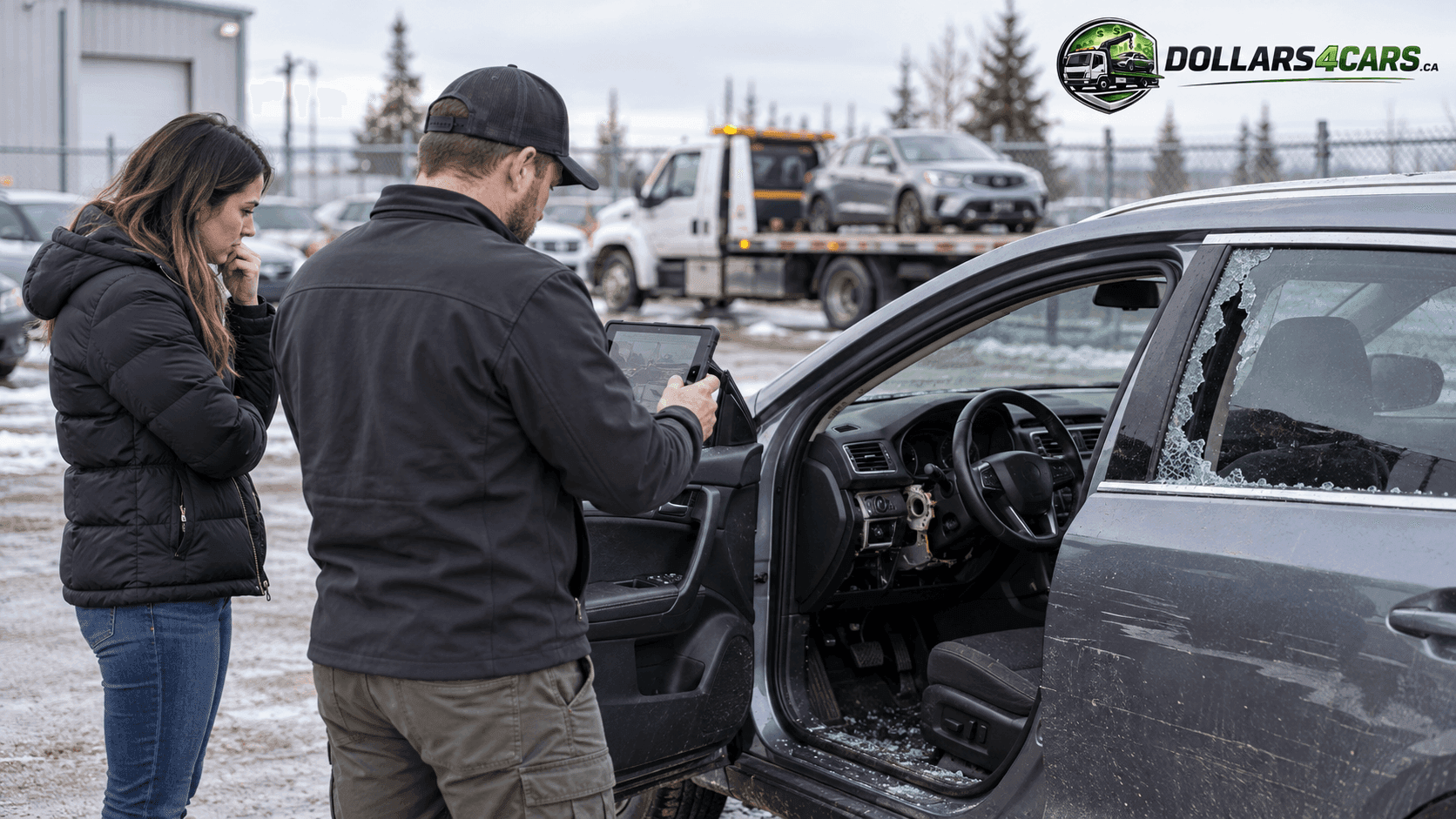
Then you see it. The steering column is torn open. The ignition has been punched. Both front seats are gone, or the dashboard has been pulled apart, or there is a burn mark where somebody tried to set it alight. The odometer shows two thousand kilometres more than when it was taken, driven by somebody who had no reason to care.
Recovered is not the same as returned. Almost nobody tells owners this in advance, and the gap between the two is where a lot of confusion, and a lot of lost money, lives. If you are dealing with a stolen recovered car in Edmonton, the next steps depend on its condition, your insurance coverage, and who legally owns it after settlement.
The Numbers Behind Your Situation
Some context helps, because owners in this position often feel they have been singled out.
Vehicle theft in Alberta has been falling. In the first half of 2026, passenger vehicle thefts in the province dropped 15.1 per cent compared with the same period in 2025, from 4,411 vehicles to 3,744. Nationally, thefts are down roughly 48 per cent from the 2023 peak.
More relevant to you is the recovery figure. Alberta's recovery rate in that period was 69 per cent, up from 67.6 per cent, and well above the national rate of about 54 per cent. That sounds encouraging until you understand what it measures. Recovery means the vehicle was located. It says nothing whatsoever about what condition it was in when found.
A car recovered as a burned shell counts in that 69 per cent exactly the same as one found undamaged in a parking lot three streets away.
What Recovery Usually Looks Like
Condition varies enormously depending on why the vehicle was taken. Broadly, recovered vehicles fall into four groups.
Taken for transport
Somebody needed to get somewhere. The vehicle is found intact with added kilometres, possibly some interior mess and a damaged lock or column. This is the best outcome and the most common for older vehicles.
Taken for parts
The vehicle is found stripped. Catalytic converter gone, wheels gone, airbags removed, sometimes seats and electronics. The shell is there and very little else of value.
Used and abandoned
The vehicle was driven hard, possibly damaged in the process, and left somewhere. Mechanical damage from abuse is common and not always visible.
Burned
Set alight to destroy evidence. There is no repair path from here.
Older, common vehicles tend to land in the first two groups. Whatever the category, the ignition and steering column are almost always damaged, because that is how the vehicle was started.
The Insurance Decision Nobody Explains Well
Theft and theft damage fall under comprehensive coverage. If you carry it, you have a claim. If you dropped comprehensive because the car was old and not worth much, you do not, and that is precisely the situation where the loss hurts most.
Where you do have coverage, two things are worth understanding.
First, timing. Many policies treat a vehicle as a total theft loss after a waiting period, often around thirty days. If the vehicle is recovered before that window closes, the insurer repairs it. If it is recovered after settlement, the vehicle usually belongs to the insurer rather than to you, and you may be offered the chance to buy it back.
Second, the repair-versus-write-off calculation. A punched ignition and damaged steering column alone can run into serious money once the column, lock cylinder and immobiliser are replaced and the keys reprogrammed. Add a missing catalytic converter and stripped interior, and the estimate on an older vehicle frequently exceeds its value. The insurer writes it off, and you are holding a settlement and a decision.
Run the deductible against the repair before you file anything. On a vehicle worth a few thousand dollars with a $1,000 deductible, a claim sometimes returns less than people expect while putting a claim on your record.
The Status Change Most Owners Discover Too Late
If your vehicle was written off and you took a buyback, its status in Alberta's records has probably changed, and that matters more than the visible damage.
A vehicle branded salvage cannot return to the road until it has been repaired and passed a rebuilt-vehicle inspection, which is a real expense and rarely worth it on an older car. A vehicle branded non-repairable can never legally be registered for road use again under any circumstances. It exists for parts and recycling only.
Owners routinely find this out months later, when they have spent money on repairs and then try to insure the vehicle. If you are deciding on a buyback now, ask your adjuster in writing what status the vehicle will carry. If the answer is non-repairable, keeping it has no upside at all.
What a Stripped Car Is Still Worth
Here is the part that surprises people. A recovered vehicle that looks destroyed often retains meaningful value, and the reason is that thieves take what is quick and portable rather than what is heavy and valuable.
The engine and transmission are almost always still in the car. Removing them takes equipment and hours, which is the opposite of what a theft involves. Those two assemblies are the most valuable components in most vehicles.
Also typically present: the radiator, the air conditioning compressor, the suspension, the differential, the fuel system, body panels, and glass. Plus the steel shell itself, which is sold by weight once the usable parts are removed.
What is usually gone: the catalytic converter, the wheels, the airbags, the electronics, and sometimes the seats. The converter is the single biggest hit, because it is one of the highest-value individual parts on any vehicle. Our guide to why the catalytic converter changes your Edmonton offer explains how much that one component moves a quote.
So the honest summary is this. A stripped recovered vehicle is worth less than it was. It is not worth nothing, and the difference between those two statements is often several hundred dollars that owners give away because they assume the car is finished. Our breakdown of what a car is worth for scrap in Edmonton shows how the remaining components are priced.
Your Order of Operations
- Get the police file number and keep it. You will need it for the insurer and possibly for the sale.
- Photograph the vehicle thoroughly at the compound, before anything is moved or removed.
- Contact your insurer and establish whether you are inside the waiting period and whether the vehicle is theirs or yours.
- Ask in writing what status the vehicle will carry after any settlement.
- Get a written repair estimate that covers the column, ignition, immobiliser and keys, not only the visible damage.
- Compare that estimate against what the vehicle is worth in working condition.
- Deal with compound storage fees quickly, because they accrue daily and can quietly exceed the car's value.
That last point catches more people than any other. A vehicle sitting in a compound while its owner decides is a vehicle losing money every day of the delay.
Frequently Asked Questions
Can I sell a vehicle that was stolen and recovered?
Yes, provided it is legally yours. If the insurer settled and kept the vehicle, it is not. If you took a buyback or never claimed, it is, and you can sell it as-is.
Is a theft-recovered car worth less than an equivalent write-off?
It depends entirely on what was taken. A vehicle recovered intact is worth close to normal. A stripped one is worth less, mainly because of the converter and wheels.
Should I repair the ignition before selling?
No. Column and immobiliser work is expensive and adds far less to the offer than it costs.
It has no keys. Does that stop a sale?
No. Vehicles are collected without keys regularly. Mention it when you call so the quote accounts for it.
What if it was recovered outside Edmonton?
Say where it is when you call. Recovery compounds in the surrounding region are common and reachable.
The Bottom Line
Being told your car has been found is not the end of the process. It is the start of a decision that gets more expensive the longer it takes, because compound fees run daily and a damaged vehicle does not improve while it sits.
Price the full repair, including the parts nobody mentions in the first estimate. Confirm what status the vehicle carries. Then weigh both against a firm offer. Our cash for cars Edmonton team buys theft-recovered vehicles in any condition, including stripped, keyless and non-running, with free towing from a compound or your driveway and payment at pickup.